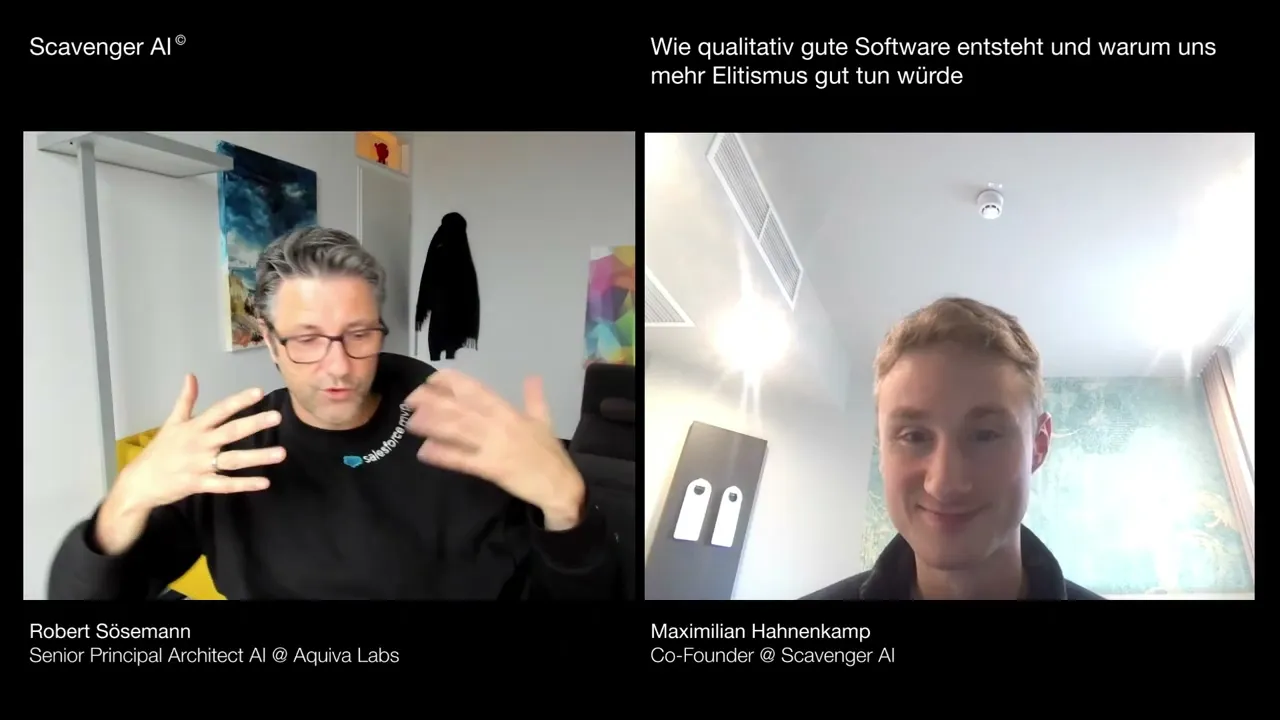
The AI debate is loud. Too loud, if you ask Robert Sösemann. The Principal Architect and long-time Salesforce MVP is not one to jump on every new trend enthusiastically, but rather he perceives things consciously. He has been working in software development for over 20 years – and today he warns emphatically that AI not only enhances productivity, but above all one thing: laziness, mediocrity, and bad taste.
In our podcast, Robert speaks openly about the current AI hype, about Agentic AI, about the future of software teams – and about why elitism in software development should not be a swear word.
From Java Student to Uncomfortable Advocate for Quality
Robert Sösemann has been active in the Salesforce ecosystem for over 15 years, and overall he has more than two decades of professional experience. Starting in the classic Java environment, he came to Salesforce rather accidentally – at a time when agile methods like Scrum and Kanban began to bring real movement into customer projects.
What made him well-known is not a hype topic, but an uncomfortable one: code quality. In 2016, Robert ported the established Java code analyzer PMD to the Salesforce ecosystem – an open-source project that brought him visibility, recognition, and also resistance.
“There are people who love me for it – and people who hate me. I polarize. And that is okay.”
Where Do We Really Stand in the AI Cycle?
Robert compares the current AI enthusiasm to the internet boom of the late 1990s. Back then, people also believed they could reinvent the world – before disillusionment set in.
His assessment today:
We have already arrived in the frustration phase. The expectations were too high, and reality is more complicated. But unlike after the dot-com bubble, Robert does not believe in a long AI winter.
“AI is here to stay. The cycle is faster. After the frustration comes the productive part.”
Does AI Really Make Software Worse?
A provocative question – and Robert's answer is surprising.
“No one has really cared about code quality. Not businesses, not developers. And AI doesn’t change that initially.”
What does change, however, is the comparison. Modern language models often write better, clearer, more understandable code than many average developers. Not perfect – but solid.
Robert does not see the actual risk in messy code, but in bugs and lack of accountability. Companies that use AI to produce bad code even faster will fail.
“AI makes good developers better – and makes bad ones obsolete.”
Craftsmanship is Not a Luxury, But an Attitude
For Robert, software craftsmanship is not a nostalgic idea, but a matter of pride and responsibility.
“Those who are proud of their work do not delegate everything to AI.”
Craftsmanship means:
understanding your own code
taking responsibility
seeing quality not as a luxury but as a minimum
His prediction is clear:
Developers without a sense of craftsmanship will be replaced. The others will stay – similar to COBOL specialists after the year 2000 problem.
Agentic AI: The Real Paradigm Shift
While many AI applications are mere playthings for Robert, he sees Agentic AI as the real breakthrough.
Not everything needs to be programmed deterministically. Especially the so-called “glue code” – business logic, special cases, transitions – can today be solved in a fuzzy, contextual, and adaptive way.
“Software is becoming leaner, more flexible – and closer to the user.”
Agentic AI enables:
less bloated software
more influence for users
fewer translation losses between business and IT
Not a short-term trend, but a decade-long topic.
Forward-Deployed Engineers: New Name, Old Truth
Even with the trend of “forward-deployed engineers,” Robert remains sober. For him, this is not a new role model, but a rebranding of what good developers have always been: customer-oriented, technically strong, communicative.
“Call them what you want. If you have someone like that: pay them well. Very well.”
These profiles are rare – and more valuable than ever.
AI Slop: Why Quantity Destroys Quality
One of the most emotional topics in the conversation: AI Slop – the flood of mediocre, meaningless AI content.
Robert does not hold back criticism:
more bad books
more bad movies
more inconsequential software
“Democratization sounds good. But if everyone can do everything, skill loses value.”
His attitude is clearly elitist – in a positive sense:
Not everyone has to do everything. Quality needs hurdles.
Open Source as a Counterbalance
A glimmer of hope: open source.
For Robert, open source is the place where people work out of conviction – not out of profit interest. Especially in the AI world, this is essential to maintain transparency, control, and quality.
“Open source is the only real protection against AI slop.”
The Team of the Future: Smaller, Smarter, More Honest
From his own experience, Robert describes how modern AI teams work:
smaller instead of larger
generalists instead of silos
fewer meetings, fewer roles, less overhead
Classic roles like Product Owner, manual QA, or pure project managers are losing significance. What matters are people who:
think quickly
communicate clearly
act pragmatically
apply AI critically but openly
“The best people often don’t like their tasks – and therefore automate them.”
Looking Ahead: Software Will Become More Personal, Cheaper, and More Radical
In the next three to five years, Robert expects:
fewer large software packages
more individually built solutions
a massive upheaval in the job market for developers
Painful in the short term. Productive in the long term.
“I would still recommend computer science to my children – but with a focus on thinking, not on tools.”