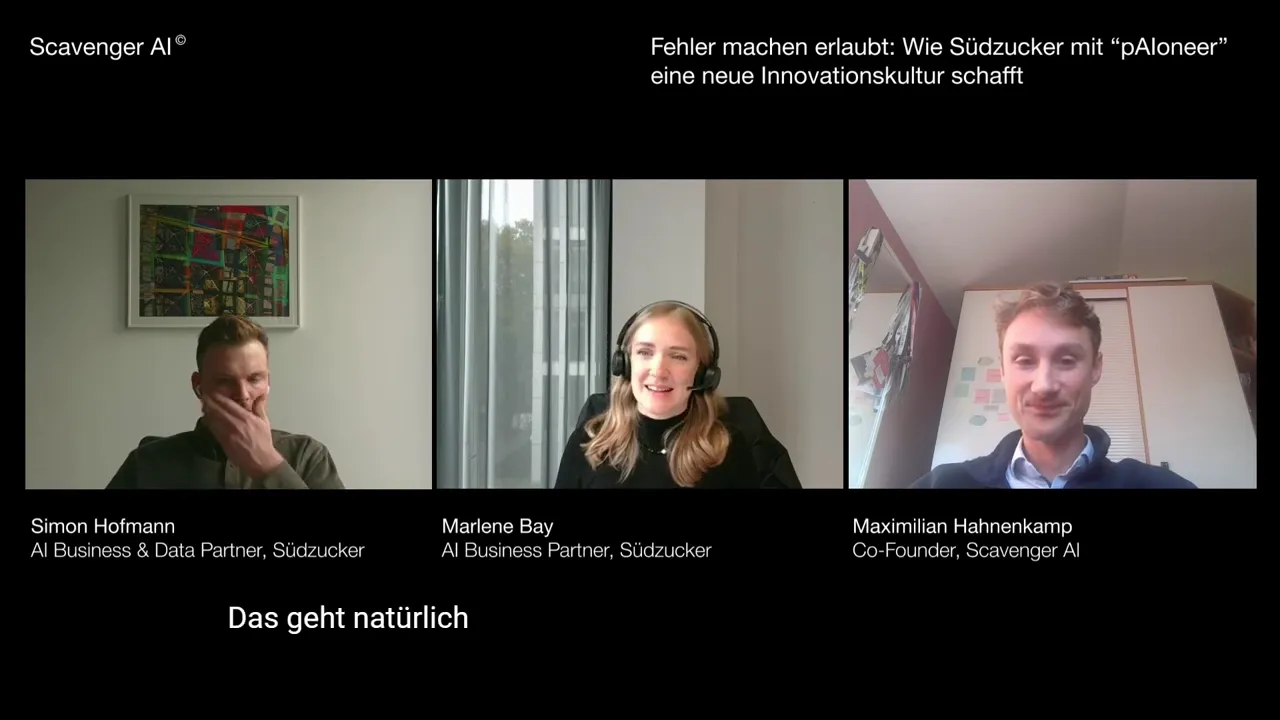
Artificial intelligence is no longer a topic for the future. For many medium-sized companies, the question is no longer whether AI should be used, but how. This is exactly where the example of the Südzucker Group shows how a clear AI strategy, combined with a lived error culture, paves the way for sustainable innovation.
With the group-wide AI program pAIoneer, Europe’s largest sugar producer has chosen an approach that is particularly relevant for decision-makers in SMEs. The focus is not on tools or technologies, but on people, processes, and the ability to continuously evolve as an organization.
Why Error Culture is the Foundation of Every Successful AI Strategy
One of the key insights from the conversation with the pAIoneer team is that innovation is not possible without mistakes. Especially with the introduction of artificial intelligence, perfectionism often leads to stagnation. Südzucker has consciously decided against this and created an environment where experiments are allowed.
The AI team operates as an independent project unit, detached from classic corporate and IT structures. This allows ideas to be tested more quickly, MVPs to be developed, and learnings to be transferred early into new approaches. For medium-sized companies, this thought is particularly relevant, as even smaller businesses benefit when AI projects are not slowed down by rigid processes.
pAIoneer Takes AI to Where Value Creation Occurs
Instead of treating artificial intelligence as a pure IT topic, pAIoneer is closely linked to the business. The AI initiative works directly with departments such as production, HR, energy management, or sales. Ownership is created where processes are understood and decisions are made.
For SMEs, this is a crucial success factor. AI only realizes its value when it solves concrete business problems and is not developed in isolation within the IT department. IT remains an important enabler, but not the sole driver of AI transformation.
Adaptability as a Competitive Advantage in the AI Age
Südzucker is a traditional industrial company operating in a highly cost-driven market environment. To remain competitive in the long term, the company focuses on adaptability rather than long-term large projects.
AI projects are deliberately started small, implemented as MVPs, and developed with scalability in mind from the outset. The goal is to create solutions that can be used beyond individual plants or divisions. This approach is particularly relevant for medium-sized enterprises, as resources are limited and investments must show quick results.
AI Applications with Measurable Business Impact
A central component of Südzucker's AI strategy is the focus on application cases with clear added value. This is particularly evident in the area of energy optimization. With the help of artificial intelligence, cooling processes in the deep-freezing production are managed in such a way that expensive load peaks are avoided without compromising product quality. Just a single plant achieves savings in the upper five-digit range as a result.
Another example is the internal HR chatbot. It automatically answers common questions on topics such as vacation, payroll, or parental leave, thus relieving the HR department. At the same time, employees experience AI in their daily lives as a concrete support. Such visible application cases are crucial for building acceptance for artificial intelligence within the company.
AI Implementation Rarely Fails Due to Technology, But Due to People
A central aha moment for the pAIoneer team was the realization that enablement and change management are more crucial than selecting the right AI tools. Therefore, Südzucker deliberately invests in training and further education programs that meet employees at different knowledge levels.
This is not just about generative AI like Copilot or ChatGPT, but about a fundamental understanding of how artificial intelligence changes processes and enables new ways of working. By taking over tasks that are repetitive or frustrating, AI creates space for value-adding activities. This increases efficiency, motivation, and innovative strength equally.
Communication and Participation as Success Factors
Another key to the new innovation culture at Südzucker is transparent communication. Through internal platforms, communities, and open exchange formats, AI projects are explained, progress is shared, and questions are answered. This is complemented by a group-wide AI ambassador community that acts as a link between the AI team and departments.
Thus, artificial intelligence is not perceived as an abstract topic for the future but as a tangible tool that concretely improves everyday work. For SMEs, this approach is particularly valuable, as proximity and direct communication are often great strengths of medium-sized enterprises.