1. Why Business Intelligence is More Critical Today Than Ever Before
Business Intelligence (BI) is no longer just a pure reporting tool. In many companies, it forms the basis for operational and strategic decisions: from sales management to cost control to forecasts, investment decisions, and resource planning.
At the same time, the environment in which companies operate has noticeably changed. Economic uncertainty, geopolitical tensions, regulatory requirements, and an increasing dependence on a few global technology providers lead to the situation where software decisions are now evaluated differently than they were a few years ago.
Notably, a large portion of the established BI platforms does not originate from Europe. Solutions like Power BI, Tableau, or Qlik were developed in the USA and are deeply embedded in American cloud and platform ecosystems.
In stable times, this was of secondary importance for many companies. However, in an environment of growing uncertainty, the question increasingly arises:
Is it sensible to anchor central decision-making and analysis systems entirely outside of Europe?
2. Dominance of American BI Providers – and Their Side Effects
The strong market position of American BI providers has grown historically. They invested early in cloud infrastructure, visualization, and self-service analytics, and continue to set technological standards.
However, this dominance comes with structural side effects that are becoming particularly relevant for European companies:
Dependence on non-European ecosystems
Many BI tools are closely linked to proprietary cloud platforms, licensing models, and product strategies that are managed outside of Europe.
Regulatory uncertainties
Data protection, data processing, and access options are subject to different legal frameworks in Europe compared to the USA. This leads to additional review and coordination processes, especially concerning sensitive company data.
Limited transparency regarding new AI features
Modern BI platforms increasingly integrate AI-powered features. It is often difficult for companies to understand how results are produced, which data is processed, and where the limits lie.
Complexity and maintenance effort
Classic BI systems often require specialized teams for data modeling, dashboard maintenance, and governance – a hurdle, especially for medium-sized organizations.
These points do not mean that American BI tools are fundamentally unsuitable. However, they explain why companies are increasingly looking for business intelligence alternatives from Europe.
3. Scavenger AI as a European Alternative in the BI and Analytics Space
Against this backdrop, new analytics approaches are emerging in Europe that deliberately set different priorities. Scavenger AI is an example of a European BI and AI analytics platform that has been specifically developed for accessing structured company data.
The focus is not on replacing existing BI systems but on a complementary approach:
Utilization of existing databases (ERP, CRM, Data Warehouse, SQL)
Operations and development within Europe
Clear separation between data access, logic, and presentation
Traceable, reproducible results
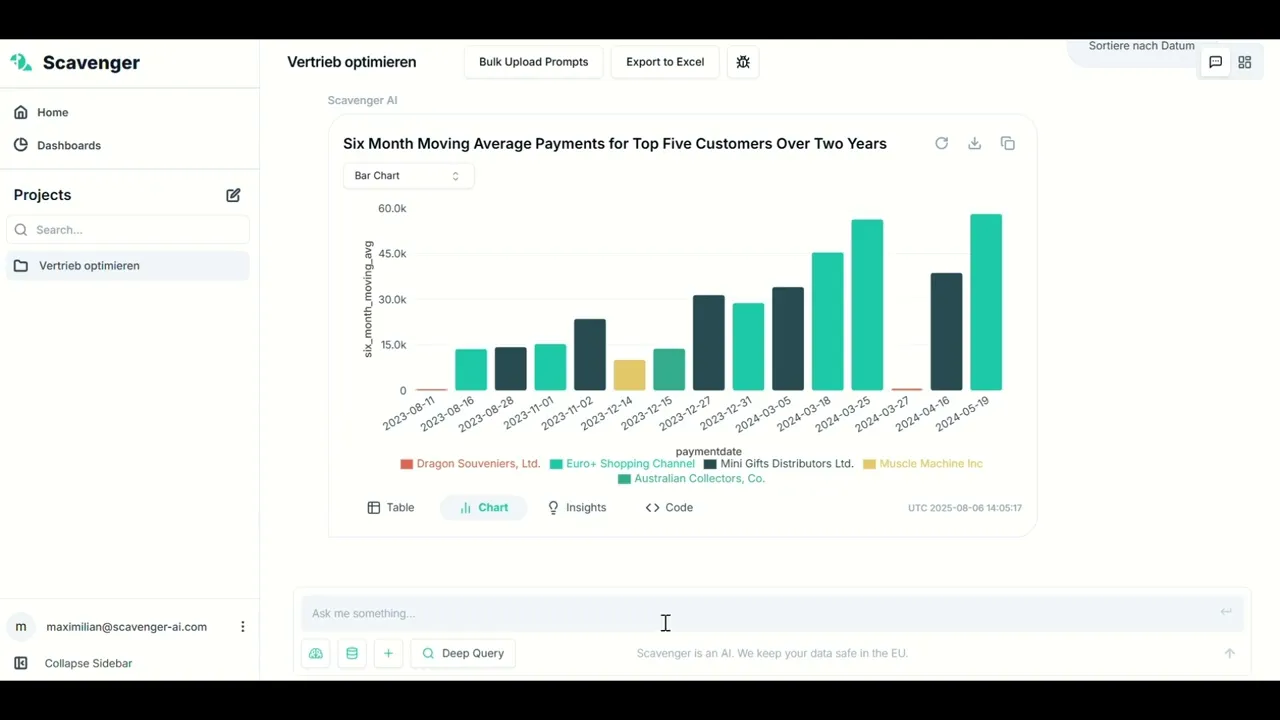
Instead of predefined dashboards, the direct access to data is at the center. End users can ask questions without having to write queries or maintain BI models themselves. The technical complexity remains in the background, while the domain control is retained.
This approach is increasingly relevant for companies that value data sovereignty, transparency, and regulatory security.
4. Difference to Classic BI: AI, Language, and New Access Models
The central difference between classic BI tools and modern AI analytics solutions lies not primarily in visualization but in the interaction model.
While classic BI heavily relies on prepared dashboards and predefined KPIs, language-based analytics systems allow for new forms of access:
Users formulate questions in natural language
The system translates these into structured data queries
Results are based on real data, not estimates
It is important to differentiate from generic AI systems. In the analytics context, it is not about creative answers but about correct, verifiable results.
Scavenger therefore relies on deterministic logic: Every answer is based on clearly defined queries and remains professionally traceable.
For controlling, finance, operations, or management, this combination is crucial:
Speed through AI – without loss of control.