Scavenger AI has systematically evaluated 68 years of the Eurovision Song Contest: 1,734 entries, 54 countries, 51,354 voting lines, and 1,722 lyrics were analyzed. The data shows which lyrics are best received, who is always right with their predictions, and whether men or women win more often.
The fan community is always right
Between 2016 and 2024, the MyESC Community (an app in which Eurovision enthusiasts from all over Europe aggregate their predictions) placed all eight winners in 7th place or better. The OGAE fan club vote, on the other hand, regularly overestimated the wrong candidates: France 2023 with 302 points ended up in 16th place, Moldova 2017 came third with zero points. Overall, the fan club placed only five of the last eight winners in their top 7. This shows here too that more data sets lead to a more reliable result, after all, the MyESC scoreboard reaches more than 10,000 users, while the OGAE has just under 900 members.
It gets interesting starting from position 11
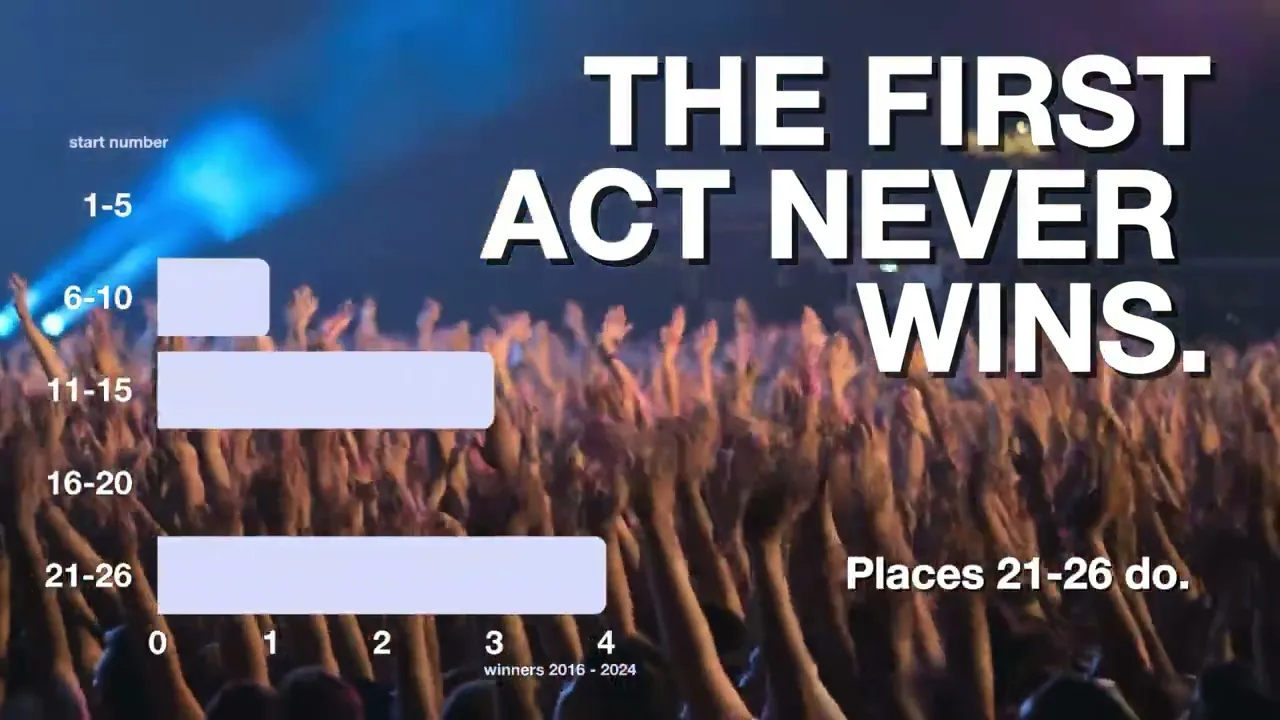
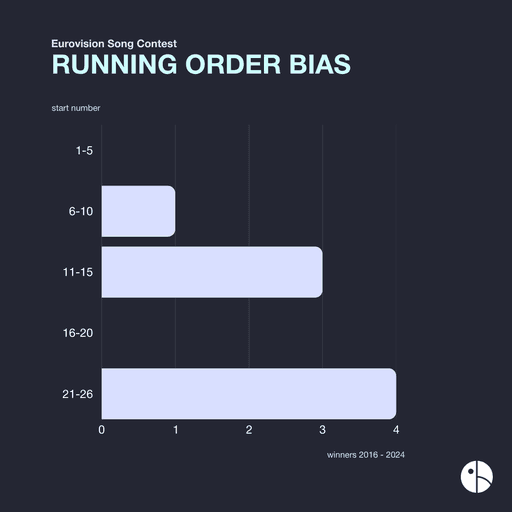
Whoever performs first loses. In eight consecutive Grand Finals (2016 - 2024), not a single country won that was in one of the first five starting positions. With an average total score of 119 points, this part of the show is the weakest segment of all. What comes after is more surprising: the end of the show does not dominate alone, but two specific windows. Slot 11 to 15 and slot 21 to 26 together produce seven of the eight winners — with almost identical overall average scores of 213 and 216 points. In between lies a noticeable slump: Slot 16 to 20 drops back to 175 points and has not a single victory to show.
Language as a Strategy
When the obligation to sing in one's own national language was lifted in 1999, the share of English-language songs jumped from 10 percent to almost two-thirds of all songs. In recent years, a counter-trend can be observed - and the catalyst for this was Portugal. In 2017, the Portuguese singer Salvador Sobral scored 758 points with the song "Amar Pelos Dois" - winning Portugal its first victory in 53 years and the highest score ever achieved at the ESC to this day. The winning song was pure, melancholic, and above all one thing: in Portuguese. Since then, the number of songs sung in the national language has been continuously increasing: from 16 percent the year before (2016) to 37.5 percent in 2018, to almost half of all songs in 2024 being non-English. And this is also reflected in the winners: 4 out of 8 winning songs between 2016 and 2024 were in their respective national languages.
Nobody wins with “La La La”
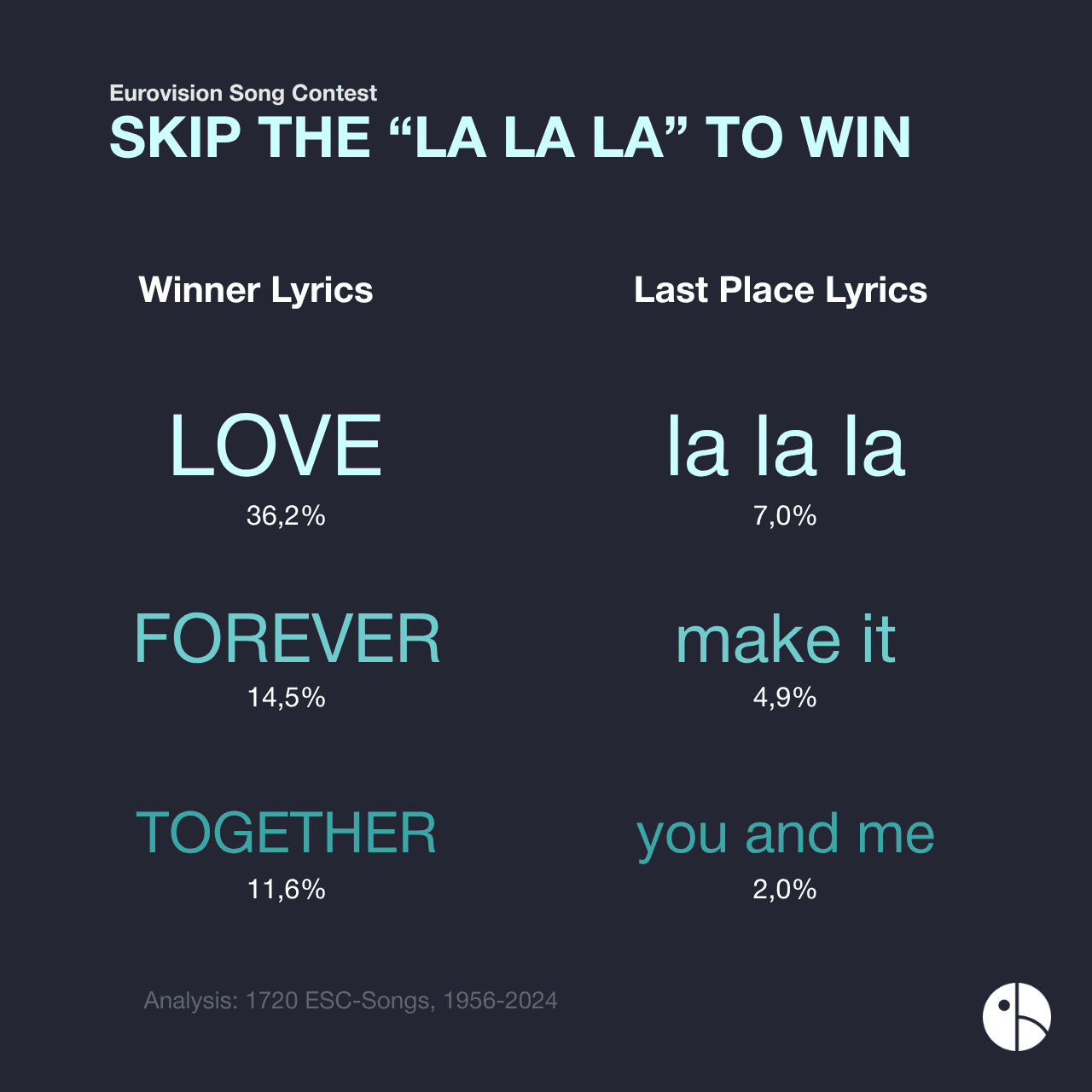
Anyone who wants to win sings about eternal love - and absolutely never “La La La”. At least, according to the statistics: the word that has appeared most frequently in winning songs since 1956 is “forever” (14.5 percent), while “La La La” is not featured in a single one - but is present in 6.9 percent of all last-place songs. These are also, on average, more negative in their lyrics, while almost two-thirds (63.3 percent) of all winning songs have a positive undertone. By the way, the most sung word on the ESC stage is “Love”, which appears in 27.4 percent and therefore in almost every third song. Paradoxically, Europe still prefers to sing about war rather than love. Because while “war” appears in 129 songs (7.5 percent of all songs), only 22 songs (1.3 percent) mention “peace”.
Placements: solo artists before solo female artists before groups
Men win more often, but only slightly. Between 2016 and 2024, four of eight victories went to male solo artists, three to women, and one to a mixed group. On average, men place in 12th.6, women in 13th.8, which is a difference of just over one place. Both groups achieved exactly nine top-5 placements in this period.
The difference between solo artists and groups is more pronounced: solo artists qualify for the final 66% of the time, groups only 60%. While six of eight victories went to individuals, mixed groups perform the weakest: lowest score, worst average placement, only one win. The field itself is perfectly balanced by gender, with 139 male and 139 female entries. The gender difference exists in the dataset, but it is too small to serve as a strategy. However, the fact that solo artists do better than mixed groups can be a deciding factor.
The data show what has repeated over decades: a solo female artist or a solo male artist, starting position between 11 and 15 or 21 and 26, a song in the native language, lyrics about love. Statistically speaking, that would be the strongest starting position for a win at ESC 2026. But at ESC, numbers are not the only thing that counts - in the end, it is above all the three minutes on stage, the music, and the moment that decide.
You can easily carry out more ESC analyses yourself: https://app.scavenger-ai.com/